• I’ve sat in dozens of board meetings and executive sessions, and I’ve noticed something disturbing: the more we optimize for psychological safety, the less truth actually gets spoken.

    Here’s the data point that should alarm every CEO: 70% of people who believe they have something valuable to say in a meeting choose not to say it. They stay silent.

    We’ve created environments where everyone feels safe to speak—and yet, nobody does. This is the meeting paradox, and it’s costing companies their competitive edge.

    This mirrors what JP Pawliw recently shared at an NACD session, where he offered thought-provoking insights on how meetings really work. His perspective stayed with me because what happens in our meetings says far more about our culture than we often realize.

    Meetings are the mirror of an organization’s culture. You only need to sit in one to see whether a company is driven by fear, by complacency, by burnout—or by productive tension.

    Why does this silence happen? It often comes down to two behavioral patterns we see everywhere. On one end, there are the avoiders—those who prefer not to rock the boat, not to contradict, not to risk being labeled “difficult.” On the other, there are the disrupters—those who talk too much, create noise, but don’t necessarily move the group toward better decisions. Both extremes hurt the quality of outcomes: silence keeps valuable insights hidden, and noise overwhelms the room.

    The problem becomes most critical in what Pawliw calls the Last 8%. His insight is that in most conversations, 92% of what gets said is easy—polite, comfortable, predictable. But the final 8% is the hard part: the truth people hold back, the feedback that stings, the dissenting view, the uncomfortable question. That’s the part most people avoid—and yet it’s exactly the part teams need to hear to make the best decisions.

    Here’s what I’ve learned as a leader: if you want the Last 8% to surface, you cannot open with your position. The moment a leader declares their view upfront—especially if done with conviction or authority—the meeting is over. What follows is theater, not decision-making.

    You can make the final call. That’s your job. But making the call and imposing your thinking from minute one are two different things. The best leaders I know ask questions, listen actively, and only reveal their hand after the room has spoken. This isn’t about being weak or indecisive—it’s about being strategic enough to access the collective intelligence you’ve hired.

    This isn’t random—it’s cultural. The way people behave in meetings reflects the type of culture a company cultivates. One helpful framework describes four kinds of organizational cultures:

    • Fear-Based: people walk on eggshells, afraid that speaking up will bring consequences.
    • Family: everything is “nice” but difficult conversations and decisions are avoided.
    • Transactional: obsessed with short-term results, tolerating poor behaviors, fueling anxiety and burnout.
    • Last 8% Culture: the ideal—high standards and high care at the same time, where trust, feedback, intelligent risk-taking, and accountability drive real progress.

    The challenge is that many leaders misinterpret confrontation. They see tension as something negative to be minimized. But the absence of confrontation doesn’t create peace—it creates indifference.

    I like to remind myself of a phrase I once heard: “A company without tension is a company where indifference reigns.” And it’s true. Productive tension is not chaos or hostility; it’s the force that pushes people to question assumptions, to raise the bar, to speak when it matters most.

    Andy Grove put it perfectly: “Bad companies are destroyed by crisis. Good companies survive them. Great companies are improved by them.”

    But here’s what Grove didn’t say explicitly: that improvement only happens if leaders create the conditions for hard truths to surface. Crisis reveals whether your culture rewards courage or punishes it. And that culture is built or destroyed in moments like the Last 8%—when it’s easier to stay quiet than to speak up, and when leaders either invite dissent or shut it down with their own certainty.

    So how can we make meetings more effective? It’s not about talking more, it’s about talking better and at the right time. Some practical ways include:

    • Name the Last 8%. Say it explicitly: “We’ve covered the easy part—what’s the tough 8% we’re not saying?” Protect space for the uncomfortable truths that usually stay hidden.
    • Invite the avoiders. Call on people by name and role: “Maria, you’ve launched three products like this—what risk are we underestimating?” This is uncomfortable because you’re putting someone on the spot, but it’s more honest than pretending silence equals agreement.
    • Balance participation. Track who speaks and who doesn’t. If the same three people have dominated the conversation, explicitly pause and say: “We haven’t heard from half the room. Before we decide, I need to hear from [names].” Yes, this slows things down. That’s the point.
    • Normalize tension. When someone disagrees or challenges an assumption, acknowledge it publicly: “That’s exactly the kind of pushback we need right now.” Make dissent visible and valued, not just tolerated. If your team sees disagreement punished even once, they’ll remember it forever.
    • Kill the meeting if nobody disagrees. If you finish a major decision and there’s only consensus, stop. Either you haven’t asked the right questions, or your team doesn’t trust you enough to speak the Last 8%. Both problems are worth solving before you commit resources. Reconvene when you’ve earned real debate, not performative agreement.

    The next time you’re in a meeting, notice who speaks, who stays silent, and whether the group is willing to voice the Last 8%—the part that actually matters.

    I’ve learned that directors who build enduring companies aren’t the ones who avoid tension—they’re the ones who architect it intentionally. The next time you’re in a critical meeting and nobody disagrees with you, don’t celebrate it. Worry about it. Because either you hired wrong, or you’ve created an environment where truth is too expensive to speak.

    The Last 8% isn’t a facilitation trick. It’s a leadership philosophy: the best decisions require someone to be uncomfortable at the most uncomfortable moment. And if you’re the leader, your job isn’t to make everyone feel heard—it’s to make sure that uncomfortable truth has more power than hierarchy.

    Because the difference between companies that survive and companies that transform often comes down to whether someone had the courage to speak up when it mattered most—and whether you created the conditions that made that courage possible.

  • Altruism is one of the most powerful forces in community life. Every time someone chooses to give something of themselves for the benefit of others, a cycle begins that multiplies both value and purpose.

    The Importance of Financial Giving

    Altruism often begins with financial giving—and for good reason. Money sustains organizations, pays staff, covers logistics, and keeps programs alive. Without consistent funding, even the most inspiring missions cannot survive.

    That’s why best practices encourage individuals to commit a fixed percentage of their resources to philanthropy.

    • Many traditions recommend the idea of a “tithe”—10% of income—as a meaningful benchmark.
    • Financial advisors often suggest starting at 3–5% of income, and adjusting upward as circumstances allow.
    • Some people prefer to set aside a portion of their savings rather than ongoing income, building giving into their long-term planning.
    • Movements like Giving What We Can encourage pledges of at least 1% of income as a simple, intentional starting point.

    The exact number depends on personal capacity and conviction. What matters most is consistency. Whether 1% or 10%, making giving a deliberate habit ensures that generosity is not occasional, but part of who we are.

    The Power of Giving Time

    Alongside money, there is another form of giving that is often even more transformative: time. Unlike money, it can’t be recovered or multiplied. When we offer it, we give something deeply personal—our energy, our attention, our knowledge, our presence. And that gift changes not only the community receiving it but also the person who gives.

    Volunteering takes many forms:

    • Ideas and expertise: a professional offering strategic advice, legal guidance, financial skills, or creative support.
    • Hands-on work: building homes, distributing food, cleaning public spaces.
    • Human connection: reading with children, accompanying the elderly, visiting patients in hospitals.
    • Ongoing commitment: engaging in the long-term development of an organization.

    From a doctor working with Doctors Without Borders to neighbors cleaning up a river, there is no hierarchy of importance. Every contribution matters when it comes from conviction.

    Choosing Where to Get Involved

    Volunteering is most impactful when there’s genuine alignment between the cause and personal values. Before committing, it helps to ask:

    • Does this mission truly matter to me?
    • Will my contribution make a real difference here?
    • Is the organization credible, transparent, and sustainable?
    • Am I looking for a one-time effort or a long-term role?

    When there’s alignment, volunteering stops feeling like a sacrifice and becomes a source of energy.

    Serving on Nonprofit Boards

    One of the ways I currently live out this commitment is by serving on nonprofit boards. This experience has confirmed for me that being on a board is one of the most demanding—and most meaningful—forms of volunteering.

    According to the National Association of Corporate Directors (NACD), all boards share the same fiduciary duties:

    • Duty of Care: making informed, responsible decisions.
    • Duty of Loyalty: placing the organization’s interests above personal ones.
    • Duty of Obedience: ensuring the organization remains faithful to its purpose and compliant with the law.

    In nonprofits, the duty of obedience carries particular weight. Directors are bound to ensure that charitable resources are used exclusively to advance the organization’s mission. Straying from that mission risks not only trust but also compliance with law and regulation.

    That distinction shapes the challenges nonprofit boards face:

    • Balancing oversight and micromanagement: effective boards provide rigorous oversight while trusting management to handle daily operations.
    • Channeling expertise constructively: directors bring professional skills that may not map neatly to nonprofit processes; the task is to translate that expertise into guidance, not directives.
    • Limited governance experience: unlike Fortune 500 boards, many nonprofit boards include members with little prior training. That creates an implicit responsibility for more seasoned directors to mentor peers and strengthen the board as a whole.

    Ultimately, a nonprofit board is not ornamental; it is the guardian of the mission. In practice, that means:

    • Providing strategic support: keeping plans aligned with mission and values.
    • Ensuring transparency: safeguarding finances and governance to sustain trust.
    • Building bridges: opening networks, partnerships, and opportunities.
    • Accompanying leadership: listening, constructively challenging, and supporting the executive team in critical decisions.

    Serving on a nonprofit board is not just governance—it is stewardship. It is volunteering at a high-impact level, where professional experience and personal commitment come together in service of something bigger.

    Giving and Receiving

    The paradox of altruism is that while you give, you also receive—often more than expected. New perspectives, meaningful relationships, gratitude, and a renewed sense of purpose.

    Whether through financial contributions, volunteering hours, or guiding a nonprofit from the board table, the message is the same: when we give, we also grow.

    As more leaders and organizations reflect on purpose-driven governance, I believe these conversations are not only valuable—they are essential

  • Leading from the Front: Why CEOs Must Be AI Practitioners, Not Just Advocates

    Nearly every survey shows the same thing: around 95% of CEOs at fast-growing companies say they’re optimistic about AI. But when you look closer, there’s a gap. Many of those same leaders haven’t actually used AI themselves.

    That disconnect is more than a curiosity — it’s a credibility problem. How do you lead people through something you’ve never done? You don’t.


    Why Delegating AI Leadership Doesn’t Work

    Here’s the paradox: most leaders wouldn’t dream of signing off on a new ERP rollout without first digging into its implications. Yet they’re fine mandating AI projects they’ve never touched.

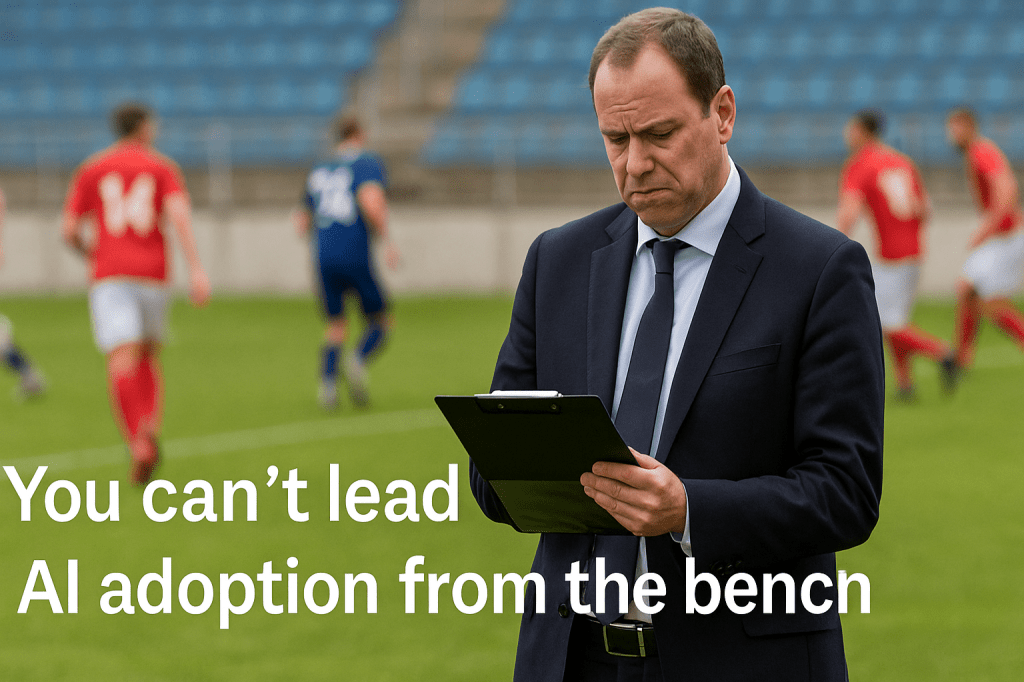
    I call this the delegation fallacy — believing you can lead transformation from the sidelines.

    The truth is, you can’t. The only way to lead AI adoption is to get your hands dirty. CEOs who use AI in their own workflow quickly see where it helps, where it stumbles, and where human judgment still matters. That’s what builds real credibility.


    Adoption Has to Flow Both Ways

    AI adoption isn’t a top-down memo or a grassroots experiment. It has to move in both directions.

    • From the top, leaders set the tone and show commitment by actually using AI.
    • From the bottom, employees discover practical use cases and roadblocks.
    • In the middle, managers turn strategy into execution and filter employee insights back up.

    When those layers reinforce each other, adoption sticks.


    Problem First. Tech Second.

    Too many AI projects start backwards. They chase a shiny tool instead of a real problem.

    The better question isn’t “How can we use AI?” It’s “What outcome do we need, and is AI the right way to get there?”

    The discipline looks like this:

    1. Pinpoint the problem — and make it specific, not vague.
    2. Define success — what changes, how you’ll measure it.
    3. Check alternatives — sometimes process fixes or training are smarter than AI.
    4. Test for fit — does this problem have the data and scale AI needs to work?

    Only then do you talk about tools or vendors.


    The Reality Check

    The hardest truth: most AI failures aren’t technical. They happen because companies overestimate their readiness.

    • Data: It’s not about volume. Is it clean, accessible, governed — and do people care about quality?
    • Infrastructure: Beyond storage, can your systems secure models and embed them into workflows?
    • People: Do your teams have the literacy and culture to adapt? Do you have the change muscle to absorb disruption?

    Sometimes the right first step isn’t a pilot, it’s six months of fixing data governance. That’s not a delay — it’s a smart move that saves you from failure.


    The Leadership Imperative

    The AI transformations that work share a pattern: leaders treat AI with the same rigor as any other strategic initiative. They start small, learn quickly, and scale carefully. They build internal capability instead of outsourcing everything.

    And most importantly, they lead by example.

    When a CEO uses AI to prep for board meetings, summarize research, or draft strategy notes, people notice. When that same leader talks honestly about prompt failures or why oversight matters, they earn trust no consultant can deliver.

    Boards and investors are already starting to expect this level of fluency.


    Moving Forward

    Adopting AI isn’t about keeping up with the Joneses. It’s about rethinking how your company creates value. That demands leadership that’s hands-on, focused on outcomes, and brutally honest about readiness.

    The question isn’t if your company adopts AI — it’s whether you lead from the front or play cleanup from behind.

    In AI, credibility isn’t declared. It’s practiced.

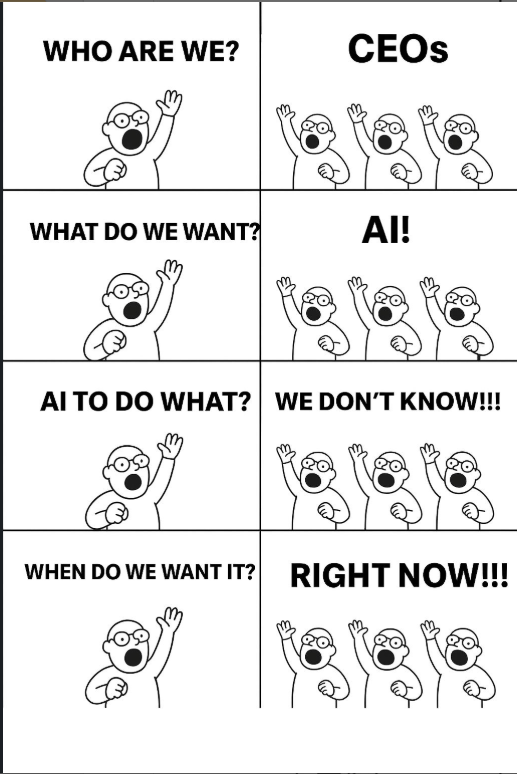
  • I found this meme funny… but also strikingly accurate.

    Many CEOs are rushing into AI with huge enthusiasm, but often without clarity on what specific problem they’re solving. The result? Exactly what you see here.

    After 3+ years partnering with companies on conversational AI solutions, I’ve seen this pattern repeat countless times. Organizations invest in AI, then wonder why they’re not seeing ROI.

    The real challenge isn’t “Do we need AI?” (we do). It’s “How do we implement it to create measurable, sustainable value?”

    Here’s what I’ve learned separates successful AI implementations from expensive experiments:

    Start with the problem, not the technology – Define outcomes before choosing tools.

    Establish clear success metrics – If you can’t measure it, you can’t improve it
    Align strategy across stakeholders – Technical teams and business leaders must speak the same language.

    Focus on value, not features – Shiny doesn’t always mean useful
    The technology is ready. What’s often missing is the strategic bridge between business objectives and technical execution.

    I’ve worked with CTOs who knew exactly what they wanted to build but couldn’t quantify business impact. I’ve advised executives who had clear ROI targets but no technical roadmap. The magic happens when strategy and execution align.

    What’s been your experience with AI implementation? Are you seeing real value — or just expensive experiments?

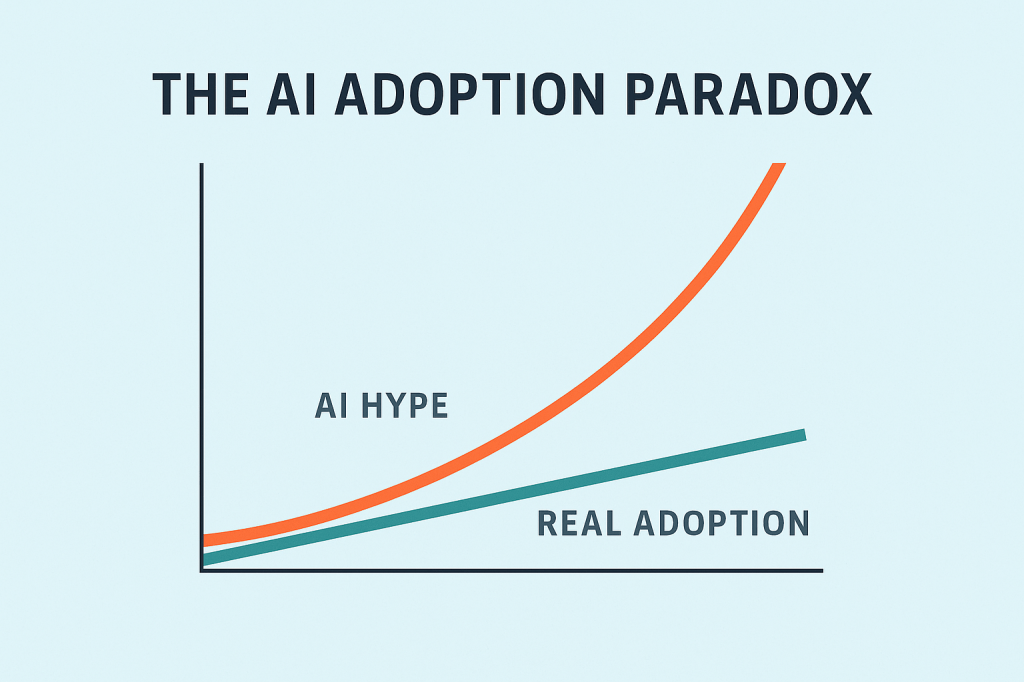
  • The AI Adoption Paradox: What I’m Really Seeing from the CEO Trenches

    Why most companies are stuck at the extremes—and the internal forces working against progress

    Something’s not adding up with AI adoption, and I think I’m starting to understand why.

    Marc Zao-Sanders recently wrote in Harvard Business Review about how Gen AI usage in 2025 splits almost evenly between personal and professional applications. Meanwhile, executives everywhere are talking a big game—Jamie Dimon says JPMorgan has 450 AI use cases, and 44% of S&P 500 companies discussed AI on their recent earnings calls.

    But here’s what bothers me: this narrative sounds nothing like what I’m seeing in the real world as a CEO.

    The disconnect is stark. According to the U.S. Census Bureau, only 10% of firms are actually using AI in a meaningful way. Goldman Sachs has been tracking companies with the biggest potential AI upside, and their stock prices have been underperforming the market. As UBS put it bluntly: “Enterprise adoption has disappointed.”

    So what’s really going on here?

    The View from the Trenches

    In my work leading an AI company and talking with organizations across different sectors, I’ve noticed something that explains this gap. Companies aren’t distributed across some normal adoption curve—they’re mostly clustered at two extremes.

    On one side, I meet companies that think they’re AI geniuses. They’ve had a few successful individual projects and suddenly they’re convinced they understand everything about enterprise AI. They don’t want outside help. They’re going to build everything themselves.

    On the other side are companies completely paralyzed by fear. They know AI matters, but they’re terrified of making the wrong move. They’ve read the horror stories and decided the safest move is no move at all.

    What’s missing? Companies in the thoughtful middle—organizations that are realistic about both opportunities and the very real internal obstacles to adoption.

    The Hidden Economic Forces at Work

    Recent research from The Economist helps explain why this polarization exists, and it’s not just about technology complexity. The real barriers are economic and organizational, rooted in how power actually works inside companies.

    Here’s the uncomfortable truth: even when executives want to implement AI, they often don’t have the real authority to make it happen.

    Think about it this way. On paper, a CEO can mandate organizational change. But in practice, the middle managers who understand day-to-day operations hold the real power. They can shape, delay, or quietly sabotage any initiative that threatens their position.

    This isn’t new. Joel Mokyr at Northwestern University points out that “throughout history technological progress has run into a powerful foe: the purposeful self-interested resistance to new technology.” We’re seeing the same dynamics play out with AI.

    Why People Resist (Even When It Makes Business Sense)

    The resistance isn’t irrational—it’s perfectly logical from an individual perspective.

    Take compliance teams. Their job is literally to stop people from doing risky things. With AI, there’s no established case law. Who’s liable if a model goes wrong? Close to half of companies in UBS surveys cite “compliance and regulatory concerns” as a main AI adoption challenge.

    HR departments have grown 40% in the past decade. They’re worried about job displacement and employee relations. Why would they champion technology that might eliminate positions?

    Middle managers face the biggest dilemma. As Steve Hsu from Michigan State University puts it, “If they use AI to automate jobs one rung below them, they worry that their jobs will be next.” So they find reasons why AI won’t work, can’t work, or shouldn’t work.

    This creates what economists call “intra-firm battles”—and research shows these fights are real. Studies of factories in Pakistan found that employees actively misinformed owners about new technology that would reduce waste but slow down certain workers. Similar patterns emerged in Asian banks trying to automate operations.

    The Board Governance Challenge Nobody’s Talking About

    This is why the polarization I’m seeing makes perfect sense—and why it represents a critical governance failure. Most companies either:

    1. Overestimate their ability to overcome internal resistance (the “know-it-alls”), or
    2. Get overwhelmed by the complexity of organizational change and give up (the paralyzed)

    Both miss the real challenge: AI adoption isn’t primarily a technology problem—it’s a board-level, company-wide governance and strategic oversight problem.

    Here’s what boards need to understand: when your executives say they have “450 AI use cases” but only 10% of companies are using AI meaningfully, that’s not a technology gap—that’s a governance gap.

    More fundamentally, it’s a strategic framing problem. Most organizations are treating AI as a tool or a series of discrete projects when it should be viewed as a company-wide transformational initiative. This misframing is at the root of both extremes I’m seeing.

    The “know-it-all” companies think technical success equals organizational success. Their boards often hear about individual AI wins and assume they translate to enterprise transformation. But celebrating isolated AI projects while missing the broader organizational implications is like judging digital transformation by the number of computers you’ve bought.

    The paralyzed companies see the organizational complexity and their boards conclude it’s too risky. But they’re treating AI as an optional add-on rather than recognizing it as a fundamental shift in how business gets done—like treating the internet as “just another marketing channel” in 1995.

    What Boards Need to Do Differently

    The few companies succeeding with AI at scale aren’t necessarily the most technically sophisticated. They’re the ones whose boards have developed governance frameworks that address both the strategic opportunities and the internal resistance dynamics.

    As someone who’s served on boards and led AI implementation, I’ve seen what works—and what doesn’t. Successful AI governance isn’t about technical oversight; it’s about creating organizational conditions where rational resistance becomes rational adoption.

    Here’s what boards should focus on:

    Enterprise-Wide Strategic Integration. AI isn’t a department-level tool or a collection of pilot projects—it’s a company-wide capability that needs to be woven into the organizational fabric. Boards should insist on AI strategies that span all functions, not just IT initiatives.

    Governance Framework Development. Don’t dismiss compliance and legal concerns—create board-level frameworks that let organizations experiment safely within clear boundaries. This requires treating AI governance as enterprise governance, not project management.

    Cultural Transformation Oversight. The biggest barrier to AI adoption isn’t technical—it’s cultural. Boards need to oversee the cultural shift from “AI as a tool” to “AI as a way of doing business.” This means changing how people think about their roles, not just what software they use.

    Strategic Incentive Alignment. Make middle managers part of the solution through board-mandated AI leadership roles. Instead of automating around them, give them new responsibilities that AI enables. This requires board oversight of organizational design, not just financial performance.

    Staged Implementation Governance. Focus first on AI that enhances existing work rather than eliminating it. Build organizational confidence through wins before tackling harder transformation challenges. Boards should demand this phased approach rather than big-bang implementations.

    Realistic Timeline Oversight. Enterprise AI transformation is a multi-year organizational change process, not a technology deployment project. Boards need to set appropriate expectations and maintain strategic patience while demanding measurable progress across all business functions, not just pilot programs.

    The Board’s Strategic Opportunity

    Market forces will eventually drive AI adoption, but boards that wait for market pressure are missing a strategic opportunity. As The Economist notes, this process will take longer than the AI industry wants to admit—the irony of labor-saving automation is that people often stand in the way.

    But here’s what many boards don’t realize: the companies that figure out AI governance now will have sustainable competitive advantages long before market forces resolve the adoption lag.

    For boards, this means recalibrating both expectations and oversight responsibilities. The question isn’t whether AI will transform your organization, but whether your board is providing the governance sophistication to manage that transformation effectively while competitors struggle with internal resistance.

    The companies that figure this out won’t be the ones with the most AI tools—they’ll be the ones with the organizational sophistication to navigate internal resistance while maintaining momentum toward genuine transformation.

    What This Means for Board Leadership

    If you’re serving on boards or in board-level leadership, your role isn’t to become an AI technical expert. It’s to develop governance expertise in AI transformation—understanding how to oversee organizational change in the context of AI adoption.

    The strategic questions boards should be asking:

    • Are we treating AI as an enterprise transformation initiative or as a collection of departmental tools?
    • How do we govern AI experimentation without stifling innovation or accepting unmanaged risk?
    • What governance mechanisms help us identify and address rational resistance before it becomes organizational paralysis?
    • How do we oversee incentive alignment across all departments—not just tech teams—to support strategic AI transformation?
    • What board-level metrics actually indicate meaningful AI progress versus just AI activity or pilot proliferation?

    The AI adoption story in 2025 isn’t really about technology capabilities—it’s about governance sophistication and the board’s role in managing the political economy of change within organizations.

    Understanding that distinction might be the difference between joining the 10% of companies using AI meaningfully and staying stuck in the 90% that are still talking about it. More importantly, it’s the difference between boards that provide strategic value and those that simply monitor financial performance.


    As someone who works with boards on AI governance challenges, I’m curious about your experience. How is your board approaching AI oversight? Are you seeing these same internal resistance patterns, and what governance frameworks are you developing to address them?

    Sources:

    “Why is AI so slow to spread? Economics can explain.” The Economist, 2025.

    Zao-Sanders, Marc. “How People Are Really Using Gen AI in 2025.” Harvard Business Review, April 9, 2025.
  • The current image has no alternative text. The file name is: screenshot-2025-04-29-132229.png

    History doesn’t just move forward—it leaps. And each leap changes what it means to be human.

    We often refer to “technological disruption,” but every so often, we face something far deeper: a full-blown revolution. These moments redefine how we live, work, think, and relate to the world around us. Today, we stand at the beginning of one of those moments: the AI Revolution.

    To understand what’s ahead, it helps to look back at the revolutions that got us here.


    The Cognitive Revolution (~70,000 years ago)
    Homo sapiens developed complex language and shared myths. This allowed for collaboration at scale—and gave us the foundations of culture, cooperation, and learning.

    The Agricultural Revolution (~10,000 years ago)
    We moved from nomadic hunters to settled farmers. This shift gave rise to cities, economies, and the first forms of organized society.

    The Writing Revolution (~3,000 BCE)
    The invention of writing transformed human memory into recorded history. It enabled law, science, trade, and education to evolve in complexity.

    The Scientific Revolution (16th–18th century)
    Empirical thinking and systematic experimentation replaced superstition with inquiry. It reshaped our understanding of the natural world and led to exponential progress.

    The Industrial Revolution (18th–19th century)
    Mechanization dramatically increased productivity and transformed societies. Factories, cities, and new economic systems emerged almost overnight.

    The Internet Revolution (late 20th century)
    Information became global and instantaneous. Communication, commerce, and learning were forever changed. The boundaries between the digital and the real blurred.

    Now: The AI Revolution (today)
    We are creating systems that don’t just execute tasks—they can reason, learn, and create. AI is not just a tool. It is an intelligence multiplier.

    It changes not just what we can do, but how we think about doing it.


    Each of these revolutions redefined the possible.
    Each challenged our assumptions about identity, work, and value.
    Each demanded new leadership, new systems, and new moral frameworks.

    The AI Revolution is no different. In fact, it may be more urgent.

    The speed, scale, and reach of AI surpass anything we’ve seen before.

    And with that, comes a key question:

    What happens if we don’t adapt?

    At a personal level, it means falling behind in how we learn, create, and make decisions. It means holding on to outdated models of productivity and relevance.

    At a corporate level, it means missing the opportunity to redefine value, to reimagine workflows, to become a magnet for talent and innovation.

    This revolution is not optional. It is happening.

    And just like those before it, those who embrace it will shape the future. Those who hesitate may be left behind.

    In every revolution, the greatest risk was standing still. This time is no different.


    How to Maximize the AI Revolution: A Personal Journey

    My adoption curve with ChatGPT: from curiosity to augmented thinking.

    I’ve worked in conversational AI for years, but using ChatGPT as a daily user has been transformative. It hasn’t just changed how I work — it’s changed how I think about productivity, creativity, and decision-making.

    Here are the five stages I experienced (and many professionals are navigating right now):

    1. Exploration: “I don’t get it. I’m confused.”
    The first time I opened ChatGPT, I felt lost. I knew I was facing something powerful, but had no idea how to apply it to my work. What should I ask? What kind of responses could I expect? I closed it more than once, frustrated.

    I learned that having access to a powerful tool isn’t enough: you need context, examples, and a willingness to experiment without fear of being wrong.

    2. Curiosity: “This is fun.”
    I returned, with lower expectations. I played with prompts, explored creative ideas, and enjoyed the surprises. ChatGPT felt like a toy box — intriguing, but still without a clear purpose in my daily workflow.

    It was a clever assistant, but not yet strategic. Still, something had shifted: I began to trust its ability to generate ideas quickly.

    3. Real Utility: “This is genuinely helpful.”
    The turning point was using it with intent: drafting key messages, structuring documents, preparing presentations, and sharpening arguments.

    The most valuable realization was that I could teach it context, build profiles, and iterate on content with an AI that “knew me.” It stopped being a novelty. It became a real competitive advantage.

    4. Full Adoption: “I can’t work without it.”
    Today, I use it to organize thoughts, explore strategic angles, validate decisions, and improve deliverables. It doesn’t replace my judgment — it enhances it.

    In a world that demands speed, clarity, and focus, it’s now an essential part of my daily toolkit. Rejecting it would be like insisting on flipping through encyclopedias after Google arrived.

    5. Maturity: “It has limits. I need more.”
    I’ve also come to understand its boundaries:

    • It can present incorrect answers with confidence
    • It struggles with financial interpretation or complex business contexts
    • It has limitations with large documents or cross-platform data

    That’s why I’ve started complementing ChatGPT with other tools based on the use case: Claude, Perplexity, Gemini, PDF-specific AI tools.

    ChatGPT remains central, but the real value lies in building an AI stack that works together across needs.

    AI won’t replace people who think. But it will massively amplify those who learn how to think with it.